Will
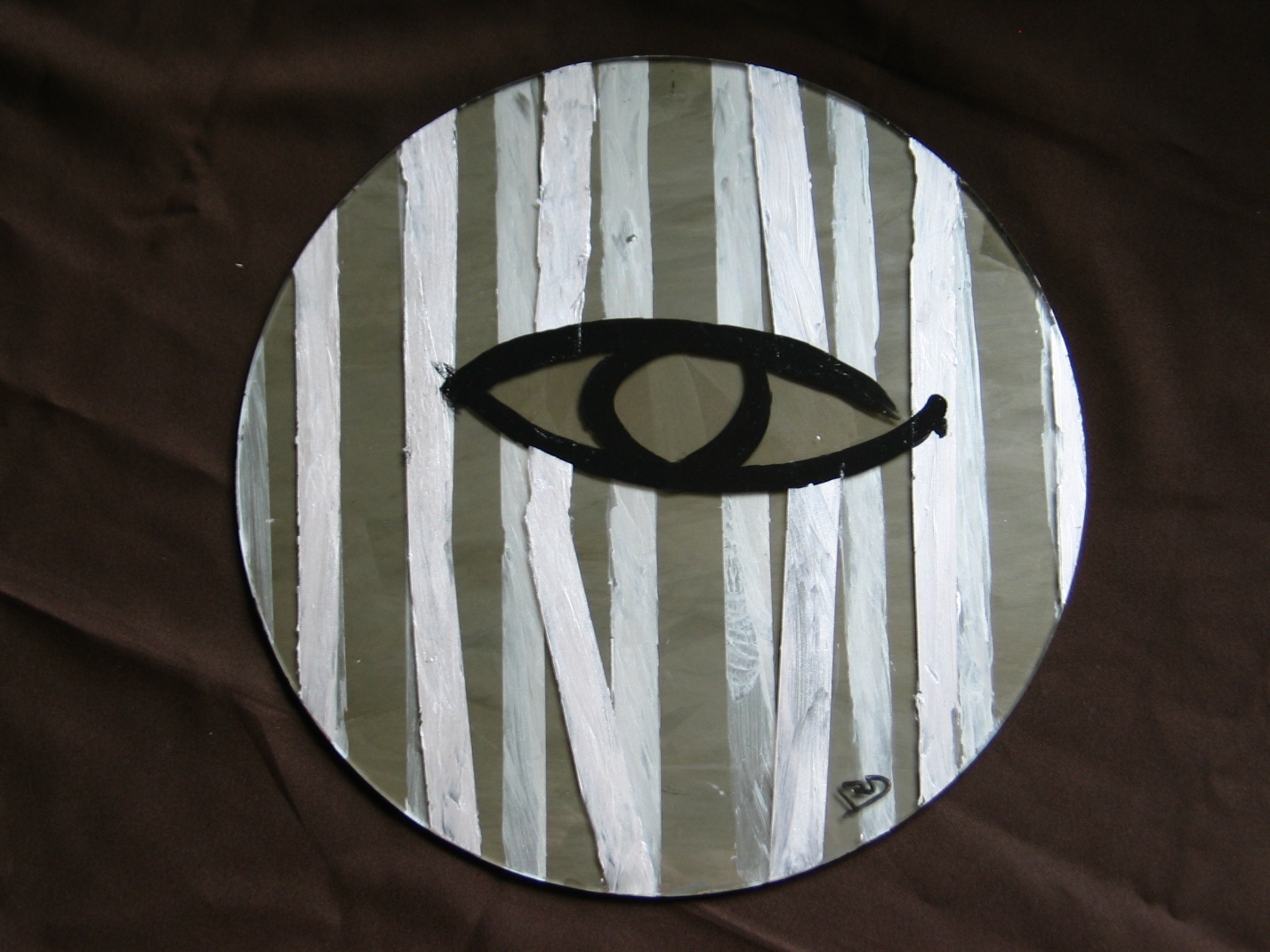
Will, an acrylic painting on a 15" circular pane of glass, emerges from the lived experience of adapting to a sudden rupture such as vision loss. More broadly, it reflects a condition in which stability is disrupted and must be reestablished under altered terms. It does not depict resolution, but a stage where direction and agency begin to form within constraint.
This is the visual language of adjustment after disruption. Not darkness, but interference. Not absence, but a reality not yet integrated. Perception continues, but no longer operates seamlessly. It becomes intentional and effortful. Disorientation has receded, though stability is not yet secured. Control is present, but still forming.
Across the circular glass surface, vertical silver bars establish a field of constraint. At the periphery, they are rigid; at the center, they yield — not through passive distortion, but in response to deliberate effort from within.
The background is a translucent gray-brown wash that filters rather than blocks light.
At the center, a large eye in dense black paint anchors the composition. Simplified but weighted, it is defined by a strong oval and concentrated pupil. It does not observe passively. It exerts. The eye meets resistance, but no longer yields.
The relationship between the eye and the bars defines the central tension. The eye presses, and the structure responds. At the lower center, the bars bow outward and separate, forming a narrow opening. The boundary is no longer fixed, but overcome through sustained engagement.
The eye is no longer contained. This marks the emergence of action. The condition remains unstable, but is no longer only endured. It is engaged.
Strength develops through this engagement. Orientation becomes more reliable, though not complete. Movement remains measured, shaped by challenge even as the world becomes more navigable.
Will describes a phase in which agency forms through effort within limitation. The structure persists, but no longer defines the limits of action. Direction is not secured, but it has begun to take shape.
This phase becomes visible after a person draws on support and resources to rise again. Fear, anger, denial, and depression have been encountered. Understanding begins to take hold, allowing the condition to be assessed and a new reality recognized. Adjustment is underway. Coping strategies are practiced. Adaptive skills and technologies are learned and applied. Possibility is no longer abstract. It has been tasted.
Identity remains in flux. What persists from before and what now belongs to the present condition is not yet resolved. The crisis still shapes perception and limits action. Autonomy exists, but is conditional, operating within boundaries not yet fully tested.
Resistance to confinement grows, as does a rejection of being perceived as diminished or fragile. A drive emerges to assert independence, test limits, and establish strength on one's own terms. Confidence appears, but it is newly formed, grounded in developing capacity and an identity still taking shape.
The condition is not yet stable, but it is no longer only endured. It is engaged directly. Potential has been seen and partly experienced. This encounter with possibility sustains forward movement, even as limitation remains present.