Understanding
The Weight of Clarity
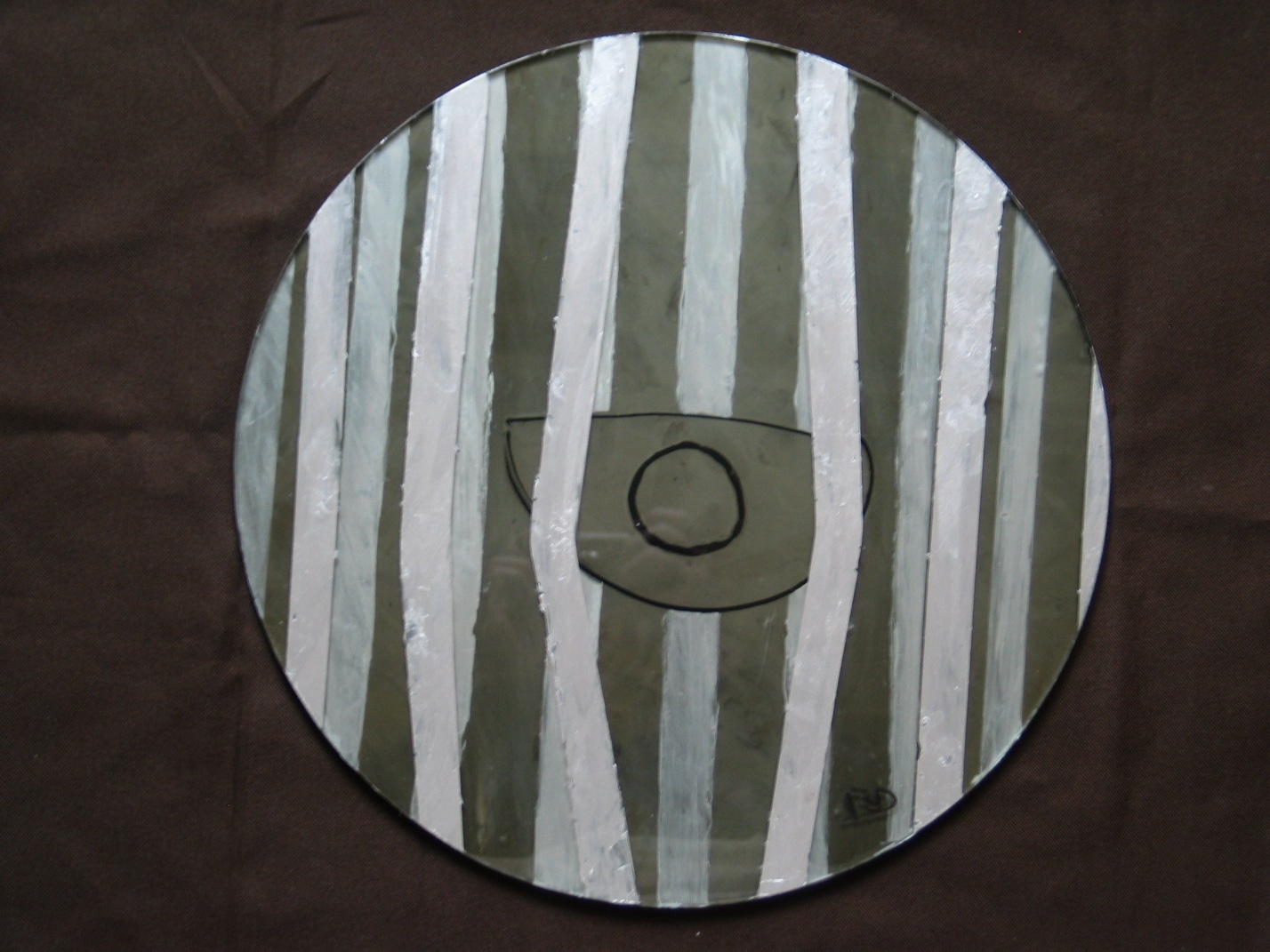
Understanding is a minimalist composition executed on a circular pane of glass, where material and image work together to shape both perception and meaning. The palette is restrained, limited to light silver, black, and a translucent gray-brown that filters light rather than blocking it. The result is an image that resists full resolution, existing in a state of partial clarity, as though seen through atmosphere.
Across the surface, vertical light silver bars dominate the composition. Slightly irregular, with uneven edges and visible brushwork, they read as barriers creating restriction. At the periphery, they remain solidly rigid. Toward the center, they begin to shift, bending and separating just enough to suggest a narrow opening — a subtle breach in what appears unyielding.
Behind these bars sits a simplified eye, rendered in thin black lines. Precise and schematic, it contrasts with the more organic quality of the silver forms. Centered on the opening, the eye suggests awareness that precedes full comprehension.
The glass surface is integral to the work. A translucent wash spreads across the background in muted gray-brown tones, allowing light to pass through while sustaining an atmospheric field. Here, blindness is not rendered as absence but as environment. Everything exists within this field, even the perception of confinement. Understanding is therefore not only external recognition but self-perception within conditions of limitation.
The tension in the work lies between restriction and possibility. The bars define space without functioning as absolute boundary. Understanding is not passive recognition but a readiness that emerges after disruption. We are not deceived by our senses so much as by our judgment.
This shift marks a movement from reaction to engagement. After shock, denial, fear, and anger, life continues in altered form. The individual begins to encounter condition not only as disruption but as reality that can be engaged. The eye occupies this threshold state. It is no longer overwhelmed, nor projecting forward. It attends to the present, beginning to interpret rather than merely register, yet recognition does not immediately produce action.
The opening comes into focus charged with unfamiliar reality. That unknown introduces doubt and hesitation. Constraints are perceived as permeable, but the capacity to move beyond them has not yet been formed.
Learning begins to take shape through experimentation, skill-building, and the gradual construction of a new framework of orientation. The world is no longer assumed; it must be reassembled. Progress remains internal, not yet enacted.
In this way, the work moves from image to lived process. It reflects a critical phase in rehabilitation, where insight has formed but has not yet translated into action. The threshold is clear. For some, it becomes a point of transition toward independence. For others, it remains an extended interval between comprehension and movement.
In Understanding, the eye neither breaks through nor withdraws. It remains aligned with the opening, suspended between recognition and action.