Stepping Off
Rehabilitation begins in the space between what was known and what has not yet taken form.
In Stepping Off, three outlined steps descend from the upper left, dissolving toward the center of a glass circle. A white cane touches the edge of the final step, a single point of contact between certainty and void. The person holding it remains unseen, present only through intention.
The next step is unpictured.
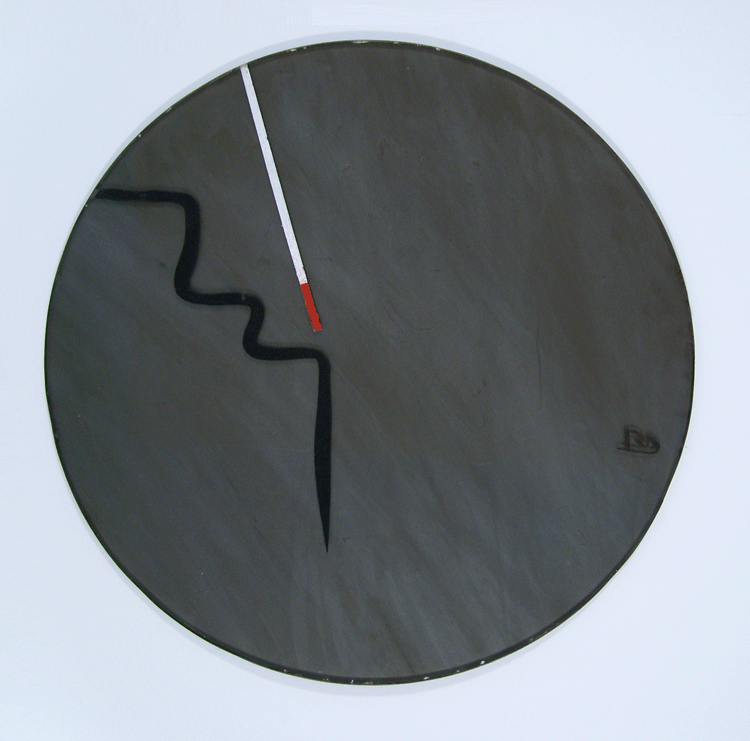
What the painting suggests visually, rehabilitation confirms in practice. Techniques and procedures matter. They keep people safe. Obstacle detection and surface identification are essential, but skills alone cannot rebuild a life. People rebuild by learning to trust a rhythm that unfolds one deliberate contact at a time. The cane tip touching the step is not a symbol of limitation. It marks the only place certainty exists. Stepping off is not reckless. It is precise, attention gathered into a single point. The next step is unknown, but the ground beneath this one is not.
Rehabilitation is often mistaken for restoration. The confusion is understandable. After sudden loss, clients and families hope that skill and time will restore life to its former order. In practice, rehabilitation demands something more difficult and more truthful. It asks people to move forward without the certainty that once structured their world.
The metaphor becomes real in my clients' lives. Working with adults who lose vision later in life has taught me that the most difficult threshold is not physical mobility; it is existential mobility. It is the courage to move forward as identity shifts, without knowing who one will become. Curbs and stairs are not merely physical structures. They mark the boundary between what was familiar and what they cannot yet picture. At that edge, they navigate memory, grief, and the fragile beginnings of hope.
One afternoon I understood why the painting hung across from us. A forty-six-year-old client came to see me after her first street-crossing lesson. She had lost her vision only months earlier. Her breath caught before the words formed, as though her body were reliving what her mind struggled to describe. Her hand trembled, caught between holding the cane and refusing what it meant. She said she wanted to move forward but could not find the place to begin. She was not waiting for permission or instruction. She was searching for the will to claim the next step as her own. She reached for hope with urgency, caught between the life she could no longer inhabit and the one she could not yet imagine. As we sat in my office, the painting across from her seemed less like art and more like a mirror. I watched her search for direction, suspended where the coordinates of her life had vanished. She was poised on the edge.
What is the next step?
I witnessed her internal crossing. For a moment, the steps in the painting seemed to reassemble, not into a staircase but into a direction. It was not a return; it was a continuation.
Art and rehabilitation share the same architecture. When I paint on circular glass, my brush does not seek the world as it appears, but as it is experienced. Not the outline of a tree, but the weight of wind moving through it. The edgeless surface echoes the disorientation of someone newly blind. Every stroke is a commitment made without visual confirmation. Once the mark lands, it joins what came before and alters everything that follows. Each stroke becomes a brief anchor in an otherwise edgeless space.
The work was never meant to depict certainty. It was meant to honor the courage to move without it. Not a guarantee. A decision.