Face to Face
Acrylic on Glass, 15″ Diameter, 2006
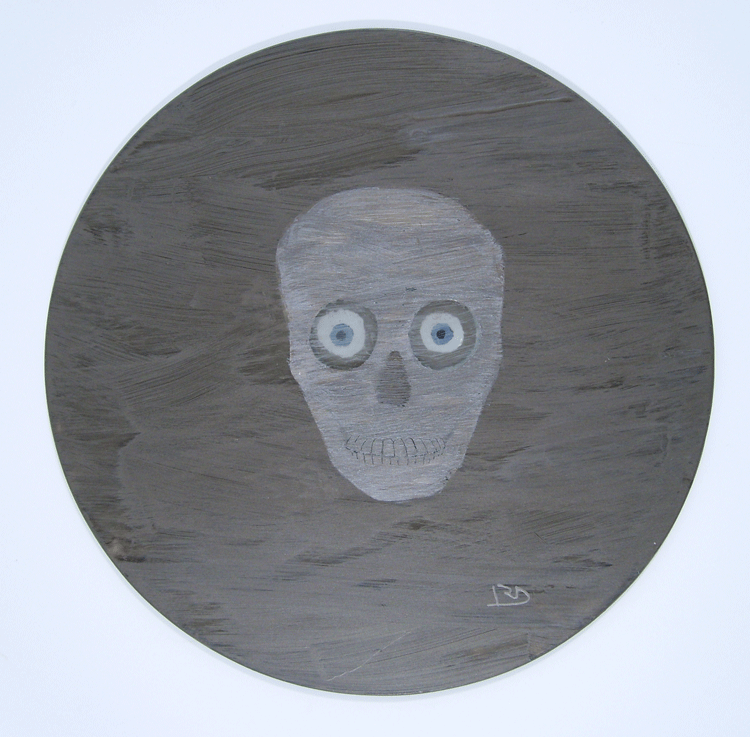
The background is a dark gray-brown, the color of my blindness, not as darkness but as atmosphere. At the center of the circular canvas, a forward-facing human skull occupies roughly a third of the space. In its hollow sockets sit two living, light-blue eyes rendered with unsettling realism. They hold the viewer's gaze with quiet certainty.
The instinct is to flinch.
The skull suggests finality; the eyes refuse it. They do not plead. They do not apologize. They simply see.
When we meet someone in crisis, we often fixate on the disruption. We highlight the condition and mistake our focus for attentiveness. In doing so, we commit a subtle violation: we address the fracture and neglect the person. We respond to the skull and ignore the eyes.
But the person is still there.
I think of this often, and of one man in particular. He arrived at a job interview carrying the very tension the painting captures: the fracture visible, the self intact, the eyes still looking. He had spent two decades training leaders and navigating corporate culture. Then, he lost his sight. The loss did not only alter his vision; it unsettled his identity. He stepped away from the labor market for months, not for the lack of skill, but to absorb a new reality. Beyond medical care, every morning required deliberate strategy. Something as simple as dressing required an entirely new system, a private architecture of order built from nothing and trusted completely before the day could begin. Nothing could be assumed. Relearning was continuous, including renegotiating his place in family and community. He was not only adapting tasks; he was rebuilding an identity. Returning to competitive employment after several months away felt like standing at a precipice. He carried fear into that interview: fear of being misunderstood, of being reduced, of being seen as incapable. The loss had stripped away the ease with which he once moved through the world. Still, he showed up. He wanted to be evaluated as a professional who happened to be blind, not as blindness personified.
The employer leaned back, feet propped on the desk, and asked how he could possibly do the job.
The dismissive posture spoke louder than the question.
The interviewer believed he was assessing risk. The qualities he claimed to value sat across the desk, unseen. And yet the man across that desk did not collapse into the assessment being made of him. What he had practiced daily was not recovery but adaptation, the disciplined art of beginning again.
Rehabilitation does not measure progress by how well a person conforms to expectation. It measures progress by how fully a person reclaims agency. It is the refusal to surrender dignity even when it is challenged. It is the decision to begin again, not because it is easy, but because there is yet more to share, to explore, to become.
The skull in Face to Face is not death. It is exposure. In that office, he chose not to internalize the posture across from him. He chose not to let narrow vision define his horizon. He left with his dignity intact, even if the opportunity was denied by prejudice.
At the edge of transformation, we are always face to face: with our fear, with our bias, and with one another. The eyes in the skull ask only one question:
What do you see when you look at me?