Dawn
Acrylic on Glass, 15″ Diameter, 2003
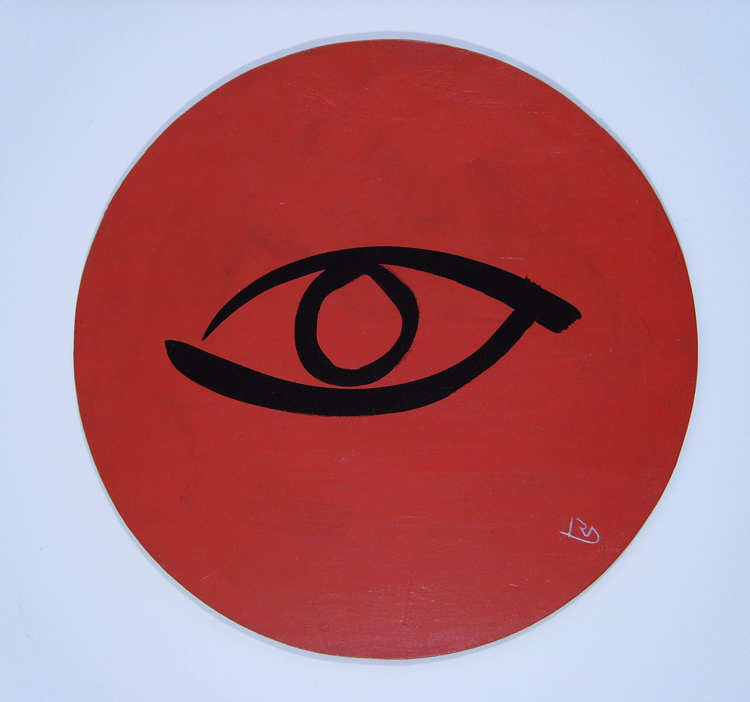
Dawn is a painting on a 15-inch circular glass. A warm pink and coral field fills the surface in soft horizontal brushwork. The field functions less as depiction of light and more as a condition of awareness in transition. Dawn presents an emergent state in which perception extends beyond optical dependence.
The painting shifts how perception is structured and understood. It moves beyond visual clarity and situates experience within a broader perceptual field where vision is one component among others. Visual loss is not treated as an endpoint, but as a reconfiguration of how reality is encountered, where what is seen, what is no longer seen, and what is known through other forms of awareness coexist within a single field of experience.
At the center is a large eye rendered in heavy, gestural black lines. The contours are thick, uneven, and fractured. The eye does not present visual stability. It reflects perception under adjustment, active but no longer anchored in clarity alone.
The pupil shows distortion consistent with reduced and interrupted sight, where clarity is fragmented. Vertical bars appear within the pupil, not as external obstruction but as internal structure within perception itself. The disruption is absorbed into the act of seeing.
Behind the bars is a vacuous space rendered in a dark grey brown tone. It suggests absence, as though something once occupied this interior field and is no longer present. The space does not resolve into darkness but holds a contained vacancy, indicating departure rather than erasure. It functions as residue of what is no longer accessible through vision.
This structure shifts the logic of the work. Vision is no longer primary or sufficient. It becomes one channel within a wider perceptual system shaped by adaptation. Visual certainty is destabilized, yet experience is not diminished by it.
What emerges is a broader form of perception that incorporates limitation without being defined by it. The subject registers impaired sight directly, while also maintaining continuity, orientation, memory, and presence through other forms of awareness. Experience continues in altered form, not as rupture, but as reorganization.
The eye is both symbolic and functional. It registers impaired sight while pointing beyond it, toward a distributed structure of perception in which seeing is one pathway among others. The vertical bars, distorted pupil, and emptied interior function as elements within this reconfigured field rather than as endpoints.
The background reinforces this condition. The warm pink and coral atmosphere does not resolve impairment but situates it within a wider field that remains open and active. It suggests continuity beyond visual limitation, where perception persists through multiple channels rather than a single dominant sense.
In Dawn, visual loss is neither denied nor framed as collapse. It is integrated into an expanded understanding of perception that includes what is seen, what is no longer seen, and what is known beyond sight. The work presents a life altered but not reduced, where perception continues in reconfigured form rather than ending at the boundary of vision. The title refers to a dawning day after transition, when perception reorients and begins anew.