Anonymous, Not Invisible
Acrylic on Glass, 15″ Diameter, 2003
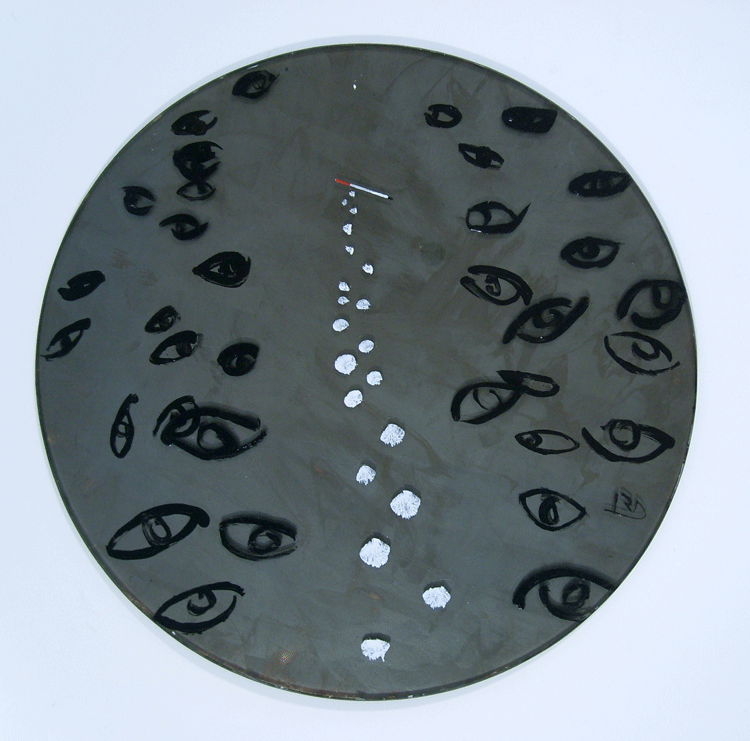
We all want to blend in, to move through the world without friction or explanation. We often imagine, wrongly, that every passerby is doing what we fear most: noticing our vulnerability. The painting holds that fear in suspension. Each eye carries its own expression, its own verdict. Together, they become a weight the traveler carries long before encountering any physical barrier.
I once worked with a woman in an intensive rehabilitation program. She progressed steadily in her cane training, yet refused to use the cane in her hometown. She did not want her neighbors to see it and conclude that she was blind.
She retained enough vision to navigate familiar streets, but the cost appeared in small hesitations. A curb discovered too late. A step taken, then withdrawn. She moved with the careful uncertainty of someone trying to conceal what her body, and often those around her, already understood.
Her fear of being labeled outweighed her need for safety. The eyes in the painting do not move, yet they seem to follow her.
Another woman accepted the need for a guide dog, but only if it were a poodle. She laughed as she explained her preference, a polished, practiced laugh that arrived too quickly. Her reasoning: composed, articulate, entirely persuasive. But it carried something it could not quite conceal. Beneath it, something less steady surfaced, a fear not of the dog, but of what the dog would make visible.
What both women resisted was not the tool, but the story it would tell on their behalf, a story written by strangers before they had spoken a word.
They stood on fragile ground between who they had been and who they were becoming. What they could not yet acknowledge was quieter: most of those strangers were not watching at all.
For a person who is blind, the social label rarely describes who she is. It describes only what she lacks. The device becomes a symbol. The symbol becomes a story. A story written before the person has spoken.
This isn't a story about sight; it is a story about the visibility of difference, a phenomenon that redraws the boundaries of every life it touches. The same quiet transformation occurs when someone moves through the world in a wheelchair, steadies themselves with a support cane, or stands apart for reasons unrelated to disability. Difference becomes the first sentence others imagine.
Imagine the street she is so reluctant to walk. A runner's footfall, too close. The rush of a store door. A cloud of perfume. Children shouting. A siren cutting through. Traffic roaring.
These impressions arrive and dissolve. She is not only being perceived. She is perceiving.
Anonymous, Not Invisible names the desire to be seen without scrutiny, recognized without reduction. It honors the quiet courage of stepping into a space where every movement feels observed. Yet the truth is simpler. Most of those eyes, real or imagined, are passing by. To make peace with imperfection is not resignation but belonging, not pity, but participation claimed on one's own terms.
It is the difference between moving through the world with apology and moving through it with steadiness. Between submitting to a visibility imposed by others and claiming a visibility that is one's own.
In the painting, the traveler continues forward.